
THE FALKLANDS CONFLICT
More information on what the Falklands Conflict was and how it affected Great Britain in 1982
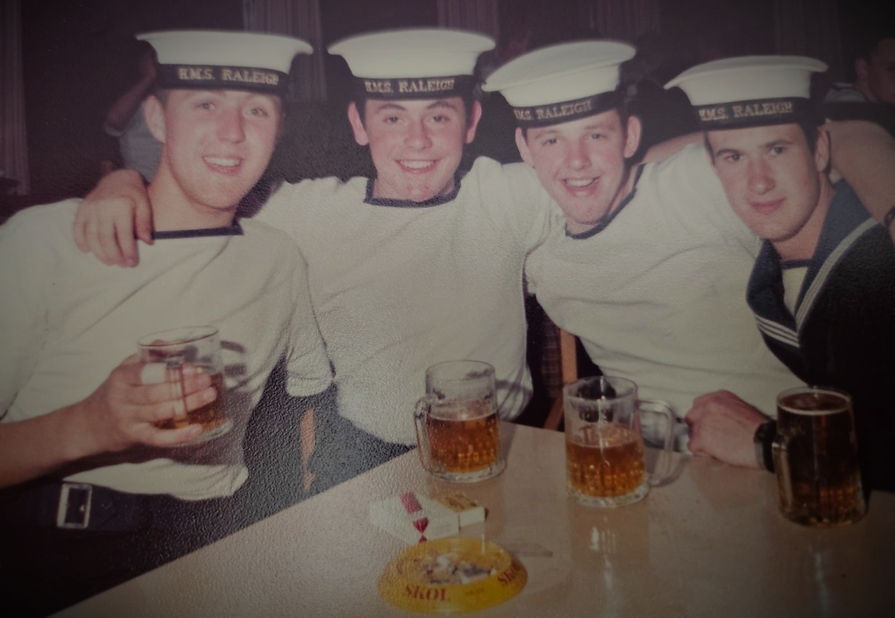
1980 at HMS Raleigh, in the ratings bar.
Depicted from left to righ: "Sid Rolt","Yorkie", "Jock", "Paddy O'Neil"

WHAT WAS THE FALKLANDS CONFLICT?
HISTORY OF THE FALKLANDS
The Falklands is a British overseas territory in the south-west Atlantic Ocean, situated off the coast of Argentina.

Tensions over the Falkland Islands stretch back well before 1982. The islands, located in the South Atlantic, were first sighted by European sailors in the 16th century, and control shifted between Britain, France, Spain, and later Argentina over the following centuries. Britain established continuous administration in 1833, which Argentina has long disputed, claiming inheritance from its earlier Spanish rule and arguing that the islands lie closer to its mainland. By the 20th century, the dispute remained unresolved but largely diplomatic.
In the early 1980s, Argentina was under a military junta facing severe economic instability and growing domestic unrest. The invasion of the Falklands on 2 April 1982 was partly intended to strengthen national unity and redirect attention away from internal problems. Britain, led by Prime Minister Margaret Thatcher, saw the invasion as a challenge to sovereignty and international law, and responded by dispatching a naval task force to reclaim the islands. The conflict that followed was shaped by geography, politics, and long-standing disagreement over ownership, ultimately escalating a distant territorial dispute into a brief but intense war.
A ROUGH TIMELINE OF THE CONFLICT
The Falklands Conflict lasted for 74 days in 1982, beginning when Argentine forces invaded the Falkland Islands on 2 April. Britain responded by sending a naval task force over 8,000 miles to retake the islands. The conflict ended on 14 June with the surrender of Argentine forces in Port Stanley. Around 255 British military personnel, 649 Argentine soldiers, and three Falkland Islanders were killed during the war.

For many people in Britain, the war became a symbol of national pride and military determination. Crowds welcomed returning troops home, and Prime Minister Margaret Thatcher described the islands as being “once more under the government desired by their inhabitants.” Yet public opinion was not completely united. Some critics argued the war was politically motivated, while others questioned whether so many lives should have been lost over remote islands in the South Atlantic.
"Taken with the Petty Officer responsible for our class during basic training at HMS Raleigh." - Martin Rolt
PTSD
The psychological effects of the conflict lasted long after the fighting stopped. Research published in The British Journal of Psychiatry found that around half of surveyed veterans reported symptoms linked to post-traumatic stress disorder (PTSD), and 22% experienced the full syndrome years later. Many veterans described survivor’s guilt, nightmares, depression, alcoholism, and difficulty adjusting to civilian life. One veteran recalled asking himself: “Why wasn’t it me?” after comrades were killed.
INTERVIEWS
In order to gain accurate research and get a feel of what our protagonist might be going through, we interviewed a series of veterans and learnt about their experiences


PERSONAL CONNECTION
"March On is incredibly personal. Having my brother deployed to the Falklands with the Royal Air Force — though having him out there definitely gave me this constant, underlying anxiety. It’s about how that feeling was reinforced afterward.
Hearing his stories about actually being there, and how much talking to the people on the ground helped him through it, really hit home for me. It completely shaped how I wanted to approach the project.
Hearing about those real, human interactions made me want to make the story bigger and deeper, so I could bring that exact experience across to the audience and show how much those connections matter when you're out there, and even when you're back home."
- Tyler Woods
Director

Martin Rolt
Falklands Conflict Veteran
"When I was younger, my father filled me and my brothers’ childhood with the lighter stories of his years in the Navy, tales told with laughter, mischief, and fondness. Only recently did he begin to speak of the heavier memories, of serving aboard HMS Diomede during the Falklands conflict.
In discovering this hidden chapter of his life, I found myself growing closer to him. Though he returned home without physical or mental scars, he carried another kind of wound, the quiet belief that he did not deserve the medal he was awarded when others had lost their lives. What struck me most was the realisation that the age I am now was the age my father was during the conflict itself.
I also realised something that felt strangely poetic in itself. My father and I both arrived in Portsmouth at the same age. I came here for university; he came here to join the Navy. In different generations, we found ourselves in the same city, each beginning a journey that would shape who we would become."