

THE STORY
Set in England 1982, March On is a psychological drama following William, a British Falklands Conflict veteran struggling to settle back into civilian life after
returning home from war.
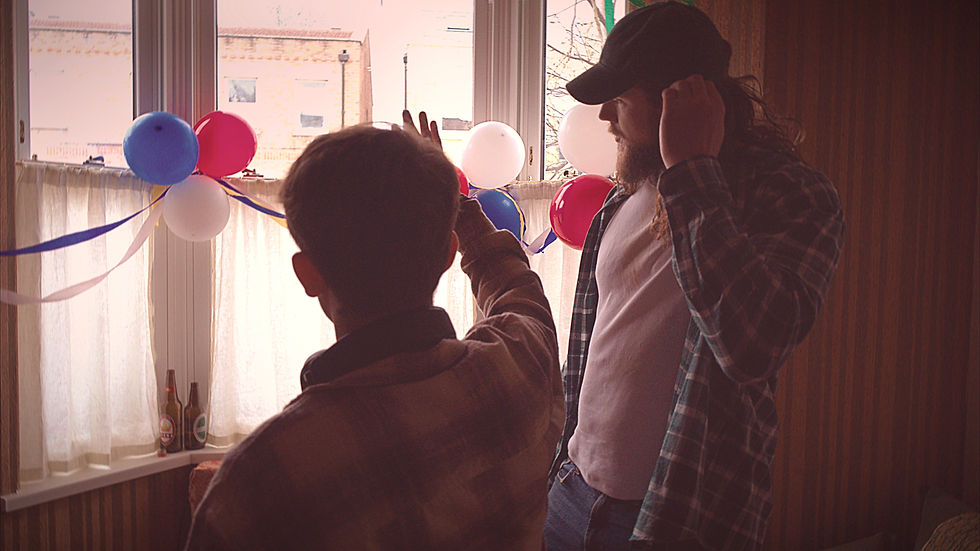
At a crowded “welcome home” gathering hosted by his wife Sarah, William tries to hold himself together and get through the night like everyone expects him to. But as the evening unfolds, the atmosphere in the house grows
heavier, and it becomes harder
for him to stay present
in the moment.
Around him, the party continues with its own tensions, old family dynamics surfacing through conversation, laughter, and pressure that fills the room. William withdraws further into himself as the night carries on, caught between what he’s feeling and what he’s expected to show.
As the storm outside begins to roll in, the mood inside the house starts to shift. With arguments bubbling in the background and the weather closing in, the night edges towards something unsteady, leaving William and Sarah at the centre of it all as everything begins to tighten around them.

A NOTE FROM OUR DIRECTOR

Tyler giving his feedback after a take
Tyler going through the blocking with our actor, Dominic

Tyler explaining his direction to our lead, Teddy
Tyler giving his feedback after a take
March On was an eventful process with its struggles and successes. However, this journey was what built the foundations of love, compassion, anger and sadness radiating from our film, and most importantly demonstrated our passion to represent the neglect of PTSD and veterans.
In the creation of this film, my aim was to keep the authenticity as prominent as I could. I felt it was vital in building a compassionate connection with the audience and helped express the nostalgic look of the 1980s we really wanted to get across.
Each crew member brought their own authentic self, skills and ideas ensuring each scene of the film did not feel simplistic, but it felt natural.
OUR JOURNEY
In September 2025, a group of ten final-year university students set out to create something that truly mattered. United by a shared passion for storytelling, they spent the following months developing a short film that would reflect both their creativity and their voices.
By May 2026, that vision became March On, a 15-minute short film shaped by collaboration and dedication. This is the story of how it came together.
1. THE IDEA
2. RESEARCH
To better understand the themes we wanted to explore in the film, we carried out in-depth research into PTSD, the Falklands War, and life in the UK in 1982, including common jobs, daily routines, and regional dialects.
We also spoke to a range of people, including a psychologist and war veterans, some of whom have been diagnosed with PTSD. After several weeks of research, we felt confident in developing a story grounded in these subjects.
At the beginning of pre-production, we knew we didn’t want to tell a conventional story. We were drawn to subjects that are often overlooked or misunderstood. After many discussions, we focused on the psychological impact of war, specifically the Falklands Conflict and its connection to PTSD.
During our research, we noticed how unrepresented PTSD was in film. Many stories lean toward surface-level, externalised and violent behaviour, but we wanted to explore something quieter and more internal. Our aim was to present a character who suppresses his emotions rather than only expressing them through violence, offering a different, more subtle perspective.
3. DEVELOPMENT
4. FUNDING THE FILM
To bring the project to life, we set a fundraising goal of £3,000–£4,000. Through a combination of a crowdfunding campaign and private donations, we exceeded expectations and raised over £5,000.
This allowed us to secure a fitting location, along with the props and costumes needed to authentically recreate the 1980s setting.
Building on these ideas, our writer developed March On: the story of a man struggling with PTSD after returning home from the Falklands Conflict.
The film weaves in themes tied to the 1980s while also reflecting ongoing conversations around mental health. It became a way for us to connect past and present through storytelling.
5. PRE-PRODUCTION
6. PRODUCTION
The months leading up to filming were intense and demanding.
Across seven months, we carried out extensive planning, from location scouting and test shoots to refining every creative and technical detail. By the time we reached production, we felt prepared to bring our vision to the screen.
Filming took place over three long and tightly scheduled days in a stunning 1980s-styled home. With a team of around 25 cast and crew members, each day came with its own challenges, from blacking out all the windows to complex sequences.
Despite the pressure, the experience strengthened us as a team and made the process all the more rewarding.
7. POST-PRODUCTION
8. FILM FESTIVALS
As March On begins its festival journey, we hope it contributes to a broader understanding of PTSD by offering a perspective that is not often seen.
Our goal is to spark conversation and raise awareness, and we look forward to sharing the film with wider audiences through festival screenings.
From March to May, the project entered its final phase. The post-production team worked meticulously on editing, colour grading, sound design, and visual effects.
Every element was carefully shaped to ensure the film reflected our original vision. It was a detailed and collaborative process that brought everything together.
9. RELEASE & BEYOND
This is just the beginning for March On. We’re excited to continue the journey and share updates along the way.
Thank you for your ongoing support, we can’t wait for you to see the film and experience it with us.